Cue the Superficial Gentry Journalism
Now that Traci Park has won her second term, you know the shallow gentry takes are going to arrive on cue. So you know we gotta get our two cents in, since nobody else qualified in Venice is going to do it.
First up is our gentry-apologist friend Nick Antonicello, the Venice columnist who dropped a tidy little list of “ten reasons” Park beat Faizah Malik 1.5-1. Read it, and it’s not much of an analysis — it’s more like an introductory writing sample to apply for a Traci Park public relations job at the Westside Current 😆. In his usual coded pro-gentry, pro-displacement buzzwords, Nick cites homelessness, public safety, incumbency, fundraising, the Palisades fire, and homeowners. Ten reasons that are generally true, with zero deeper analysis behind any of them.
But let’s rewind the track a little. If you remember, back in 2022 our boy wasn’t even a Park supporter. He spent that cycle chasing the “moderate middle” and calling Park the “right-of-center, law and order” pick — not exactly the PR love letters he’s writing about her now. I’m used to disagreeing with him on most things, but I’ve known him to bring at least a slightly more critical analysis to the topics he covers. Lately, though, his pieces come off more like bandwagon narration.
I don’t mean to single him out — he’s prolific on social media and across the web’s political pundit circuit. He’s just the most notable one that initially came to mind, just one example of the displacement apologism posturing as objective journalism. But this is how all the Westside right-wing grooming rags like Westside Current, the Santa Monica Mirror, and Yo! Venice, and the wanker liberal publications like the Argonaut narrate the Westside. They fight about politics and agree on one thing — keep it shallow. Same race-blind, class-blind, donor-blind coverage every time, treating an election like a superficial contest over somebody’s favorite ice cream, never touching who’s behind the war chests or who’s getting harmed and made invisible by the (lack of) coverage itself.
All ten of his reasons are technically true, but at the same time, they tell you nothing. Not one critical-thinking question, like: Who benefits from these policies? Who gets harmed by them? And because his ten reasons are superficially true as framed, the average reader just accepts the whole thing as gospel, without ever fact-checking whether the reasons people voted for Traci Park hold up in the first place.
So let’s get into it and smash these superficial, dishonest, and deliberately lazy takes on the dynamics and facts that really went into Traci Park’s win over Faizah Malik.
Colorblind Racism, No Racial or Class Analysis
Read all ten reasons again and notice what’s missing. Not one of them touches race or class. In a district sitting on the bones of Oakwood’s Tongva, Black, and Chicano community — in a city that’s been gentrifying Brown and Black families off the Westside for almost forty years — a nice guy from the neighborhood wrote ten whole reasons about a CD11 election and never once mentioned either one. This isn’t to put Nick on blast; he’s a genuinely nice guy. But a lot of his takes are dismissive of racial and class analysis, and this one’s no different.
There’s a name for what he’s doing. The sociologist Eduardo Bonilla-Silva calls it colorblind racism — the book is Racism Without Racists, and it’s required reading if you want to understand the everyday operating manual of the Westside gentry. His argument is simple: after the civil rights era, people stopped needing slurs to maintain inequality. They just needed clean, race-neutral language.
You don’t say you want to keep the neighborhood white — you say you care about “public safety.” You don’t say you want poor Brown families pushed out — you say you want it “safe and clean.” And you don’t say you’re against evidence-based housing solutions and racial equity — you say you’re voting for “common sense” over “ideology.” Same outcomes. Cleaner hands.
Notice the trick in that last one: when their politics protect property values and police budgets, that’s just “common sense” — neutral, obvious, apolitical. When our politics protect tenants and unhoused people, that’s “ideology” — radical, suspect, dangerous. Both are ideologies. Only one side gets to pretend it isn’t. Traci Park’s whole PR operation runs on this vocabulary.
Bonilla-Silva breaks down the specific moves, and a couple of them are all over Nick’s list. There’s naturalization — explaining away a rigged outcome like it’s just the weather. “CD11 is more conservative.” “Homeowners turned out.” As if the district simply ended up this way on its own, and not through decades of displacement, divestment, over-policing, and deliberate decisions about who got to stay and who got pushed out. Then there’s minimization — “conditions improved,” “voters felt safer” — said with a straight face, no numbers, no fact-checking, no mention of who those conditions improved for or who’s getting displaced to make it look that way.
That’s the engine under the whole piece. Every “reason” listed is a race-neutral wrapper around a race-loaded reality. He doesn’t have to be racist or even know he’s doing it — that’s the genius of the framework (even if I’ve pointed it out to him plenty of times before). The language does the work for him. He gets to write ten reasons that sound perfectly reasonable and never once make a reader uncomfortable enough to ask who paid for Park’s victory — or whether the victory was as easy as the mandate he makes it out to be.
You don’t say you want to keep the neighborhood white — you say you care about “public safety.” You don’t say you want poor Brown families pushed out — you say you want it “safe and clean.” And you don’t say you’re against evidence-based housing solutions and racial equity — you say you’re voting for “common sense” over “ideology.” Same outcomes. Cleaner hands.
And the fastest way to strip the race-neutral wrapper off this election is to look at the numbers left out. So let’s count.
The Numbers Context that Gentry Media Won’t Show You
Here’s the number that should’ve been reason number one, and didn’t make list at all: 47,056.
That’s how many people voted for Erin Darling in 2022 — a progressive who came within about four points of taking this seat. So hold that up against the line most gentry pundits lean on, that CD11 is “just more conservative.” A genuinely conservative district doesn’t nearly elect Erin Darling. Four years ago, a progressive pulled 47,000 votes here and almost flipped the Westside. That’s not a conservative district. That’s a contested district that gets made to break right — and an alleged conservative district and a contested district getting made to break right are two very different things.
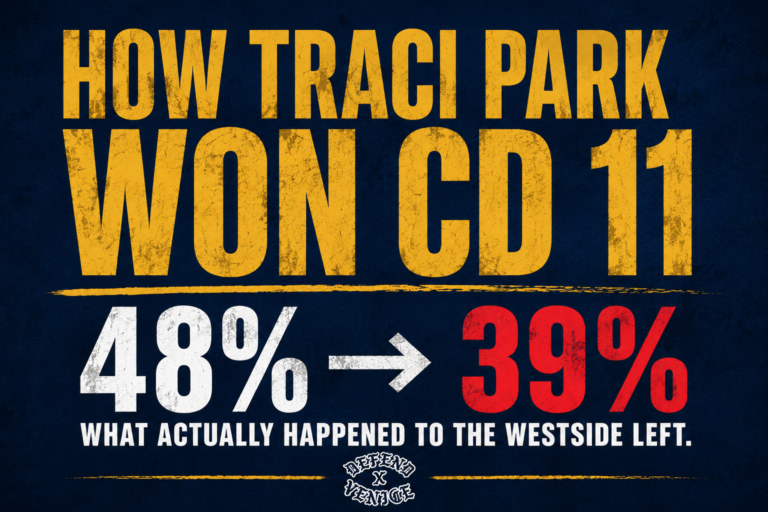
So the real question is why a progressive lane that hit 48% in 2022 came in at 39% in 2026. Faizah Malik pulled 32,402 votes — not a fringe number by the way, tens of thousands of her neighbors. What changed between a near-win and a clearer loss?
By the numbers:
- The progressive vote didn’t collapse — it slid: Darling nearly flipped the seat at 47,056 (48%) in 2022; Malik pulled 32,402 (39%) in 2026.
- Turnout structure: 2026 was a low-turnout June primary (~82K ballots) standing in as the general, vs. 2022’s high-turnout November general (98K ballots) — fewer voters, skewed older, whiter, homeowner.
- Race: CD11 votes over 60% white (electorate whiter still); Malik would’ve been the first non-white councilmember in district history.
- Homeowners: owners vote ~58% vs. renters ~37% nationally; CD11’s coastal homeowner core turns out, its renters largely don’t.
- The ~40% non-Democratic bloc: 14% Republican (double other progressive-target districts) + ~26% NPP = roughly 67,000 kingmaker voters backing a moderate with a (D) for cover.
- Money: Park’s side spent near-record sums to hold the seat — roughly $3.8 million working to elect her (her own committee plus the independent expenditures boosting her), against about $980K total on Malik’s side. Nearly a 4-to-1 advantage. (Full breakdown later.)
Here’s the trajectory that should’ve played out. By her campaign’s own account, Malik ran a more mature, more polished, better-resourced operation than Darling did. More money, more doors, four more years of mostly the same coalition sharpening its game. A June primary caps the raw vote for everyone, so let’s look at the share instead, since the share doesn’t care how many people showed up. Darling captured 48% in 2022. You’d expect a better-resourced, more polished campaign, with four more years of organizing, to at least hold that — if not grow it. Instead, the progressive share slid to 39%. That nine-point drop is the real story, because it’s the one number voter turnout can’t explain away. Fewer voters explain a smaller raw count. It doesn’t explain why the same campaign lane that ran better captured a smaller slice of whoever did show up.
The doors got knocked. The work got done. The campaign wasn’t the problem — the calendar, the incumbency, the money, and the media machine came through for her win.
Start with the June-versus-November voting dates. In 2022, CD11’s race went to a November even-year general — the highest-turnout election there is. Nearly 98,000 people voted, and Darling rode that high-turnout wave to 47K and a near-win. In 2026, Park cleared 50% in the June primary, so there was no November runoff at all; the whole thing got settled in a lower-turnout spring primary, about 82,000 ballots. That’s roughly 16,000 fewer voters — and primaries don’t just shrink the electorate, they reshape it. The voters who fall away in a June primary skew younger, poorer, renter, Browner — the progressive lean. The ones who always show up skew older, whiter, homeowner.
The progressive vote here grows when the electorate does. So much for the narrative of a fringe progressive base that can’t crack the Westside; in reality, it’s a base that nearly took the seat in 2022 and got clipped by a calendar in 2026.
But none of that suggests the election fight would be easy under more favorable circumstances. Darling rode that high-turnout wave and still came up four points short, because of the numbers I’ve never seen local media acknowledge before.
- CD11 is about 40% non-Democratic
- 14% of registered voters here are Republicans — nearly double the Republican share in any other district progressives target in this city
- –plus another quarter are No Party Preference.
That’s roughly 67,000 voters outside the Democratic Party in a district everyone calls “blue.” They can’t elect an open Republican; the Westside won’t pull that lever. So they do the next best thing — consolidate behind a moderate (read right-of-center) who delivers the policing and the property protections they want, with a (D) next to her name for cover. That’s Traci Park.
But difficult election organizing is not the same as hopeless, and the Westside displacement press is counting on you to confuse the two. They want the left to read 39% as proof that progressive, anti-racist, pro-equitable-housing policies don’t belong here. The truth is the opposite: a structurally disadvantaged progressive, in the worst-possible election slot, against an incumbent machine and a near-record money flood, still pulled 32,000 of her neighbors with her.
So who actually got filtered out of the 2026 result? The renters, the working-class families, the Brown and Black residents most affected by Park’s sweeps, her policing and pro-incarceration budget, her pro-corporation housing votes — the people with the most reason to vote against her are the least likely to make it into a low-turnout June primary. The election that judged Traci Park’s record systematically thinned out the people her record hits hardest.
More than a third of the district’s residents are Black, Brown, or Asian, sitting on the bones of a once far more diverse Westside community. And in the district’s entire history, not one of them has ever held this seat. Faizah Malik would’ve been the first. That’s not an accident of who was qualified to run. It’s a measure of who actually votes here and who gets left out.
Then there’s the money, which we’ll come back to in detail later. For now, check this — it took roughly $3.8 million to elect Traci Park — her own campaign cash plus a flood of independent money from the police union, corporate real estate, and MAGA-adjacent donors — against under a million on Malik’s side. Close to 4-to-1. The ratio isn’t even the main issue. The more damning point is who wrote those checks and what they expected in return. We’ll open that box later.
For now, the point is this: the numbers don’t show a beloved leader sweeping to a mandate. They show a real progressive base, one that nearly won in 2022 , running uphill in a lower-turnout primary, against a mature incumbent machine, a near-record flood of money, and a district built with a non-Democratic bloc big enough to tip it. But the numbers only take us so far. They explain most of the gap between Darling’s near-win and Malik’s loss, but not all of it.
it took roughly $3.8 million to elect Traci Park — her own campaign cash plus a flood of independent money from the police union, corporate real estate, and MAGA-adjacent donors — against under a million on Malik’s side. Close to 4-to-1.
Local Gentrification Media and Manufactured Consent
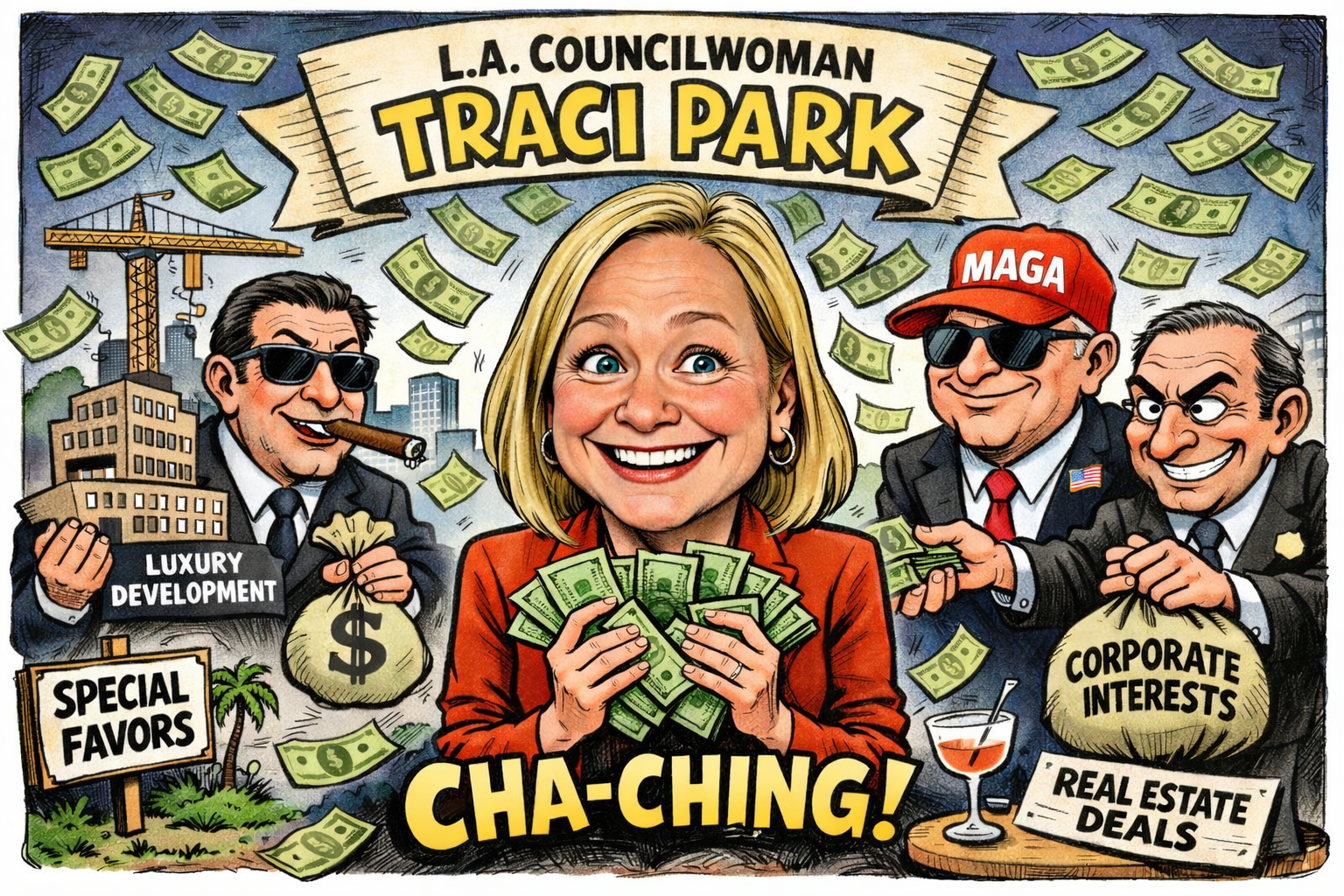
So how does a record like that— encampments swept off the sidewalks while the number of people actually sleeping outside held flat, a fire she sat out, corporate real estate displacement, donors straight off the MAGA roster — get sold to a whole district as a success story? Easy. Spin and propaganda.
Since I can be a research geek sometimes, let me share some: in 1968, two researchers, Maxwell McCombs and Donald Shaw, ran a study in Chapel Hill and found something that’s been confirmed by more than 400 studies since — the media doesn’t have to tell you what to think. It just tells you what to think about. Control which issues are on the table, and how they fget framed, and you’ve won the argument before anyone opens their mouth. They call it agenda-setting.
One landmark study found that Fox News exposure alone pushed 11.6% of non-Republican viewers to vote Republican. Newspaper endorsements reliably move another 2 to 6 points. Now stretch that across six years of the Westside Current with no left-leaning outlet of remotely equal reach to answer it — and you start to see how you help manufacture a 20-point spread.
Now apply it. Park’s machine — over two million dollars in mailers and digital, plus the six-year, year-round drumbeat of the Westside Current — spun this entire cycle into being about exactly two things: encampments and “public safety.” That’s the agenda. And once the whole district is staring at that one frame, Park wins, because that’s the turf her money built and her donors paid for.
For anybody who forgot: the Westside Current’s founder, Jamie Paige, also served as Traci Park’s communications director and is also a contributor to one of the most obnoxious right-wing tabloids. The “local news outlet” covering the councilmember is run by the councilmember’s former press secretary, but I’m sure she’s still very internally active. They run enough legitimate-looking journalism to check the box, but embedded in the work is a steady current of messaging that serves Park’s agenda — and a broader right-wing grooming of the Westside that goes unchecked, because there’s no authentically left publication funded at anywhere near that level to counter it.
So when the online trolls bark that Faizah Malik “couldn’t connect” on housing — no. Malik ran hard on housing and tenant protections and unlike Traci, with verifiable receipts.. The problem wasn’t her message. It’s that her message had to go head up with the momentum of a right-wing grooming machine that spent six years planting fear-based ideas into certain words — words that would later get hung on Malik and her policies. By the time she said “housing,” it had already been filtered through a frame built to discredit it. That’s second-level agenda-setting — not just what you think about, but how it’s painted before you even look. So, Malik was also fighting a media beast that took more than half a decade and millions of dollars to build, with no real media counterforce on the other side. That’s a lot of hard programming momentum to break.
So let’s talk about the voters. Park’s propaganda operation is genuinely top-tier, we’ve always acknowledged that. But her racist and classist record isn’t a secret. The donor sheet is public. The hygiene removals and the displacement of working-class people by corporate real estate is well documented. And those homelessness “results” she ran on? By the RAND field counts — the most consistent data we have, since clean district-level numbers stopped after 2022 — the unsheltered population in core Venice barely moved across her whole term, while the people sleeping with no shelter at all actually went up. The tents got cleared. The people didn’t go anywhere. All of this is a two-minute Google search away. So sure, some folks just got okey-doked by the propaganda. But most of them? They know what’s up. They did the math on their property values and decided that their comfort and business goals outweighed those of working-class families, renters, and the whole Black and Brown Westside that used to have a place here.
Which brings us back to Bonin — arguably the reason the Westside Current exists in the first place. If the Westside press, with their documented propaganda and outright lies, just sold you a fairy tale about Park, how much of what they fed you about Bonin was actually true? And I say that as someone who publicly held Bonin accountable on multiple fronts while he was in office. I’m down for accountability. But what I’ve never been down with is pinning a narrative on somebody that the gentrification media outlets manufactured to clear the lane for his right-wing replacement.
So when the online trolls bark that Faizah Malik “couldn’t connect” on housing — no. Malik ran hard on housing and tenant protections and unlike Traci, with verifiable receipts.. The problem wasn’t her message. It’s that her message had to go head up with the momentum of a right-wing grooming machine that spent six years planting fear-based ideas into certain words — words that would later get hung on Malik and her policies
The same people who told you Bonin was the villain handed that seat to a former Republican whose campaign leaned on a Heritage Foundation trustee and paid Breitbart consultants, and who lied about organizing for Obama. Consider the source. The consent was manufactured. It only worked because the ground was already prepped to receive it.
Faizah Had the Same Campaign Model as Darling, But No One’s Talking About This Factor
So, between the turnout structure, the money, and the media machine, we’ve covered a lot of the ways Park won. But there’s an additional factor that every other publication won’t ever acknowledge or touch. If Faizah Malik essentially had the same campaign machine as Darling — with four years more practice, more money, more doors — how did the progressive lane go from a near-win to a nine-point loss? Erin Darling took Park to a near-tie in 2022, finishing at 48%. Faizah Malik, running the more polished version of that same campaign, landed at 39%. A better operation produced a worse result. How?
We’ll remind you of the easy facts first.
One: incumbency. Darling ran for an open seat in 2022 — nobody was the incumbent. Malik ran against a sitting councilmember with all the built-in advantages we already covered. Incumbency is basically the Monopoly player who got to circle the board a few times before anyone else rolled the dice — already sitting on hotels while you’re still counting out your starting cash.
Two: the Palisades fire. Whatever the truth about Park’s actual role in that disaster — and there’s a Senate report and her own on-record words that complicate the hero story — the fire handed her a year and a half of being the public face of recovery. That’s a powerful continuity pitch, and Darling never had to run against anything like it.
Three: the media machine. As we just laid out, six years of the Westside Current and over two million in mailers and digital built a frame that Malik’s message had to fight through before it could even land. Darling never faced a propaganda operation that entrenched.
So we need to acknowledge those very real advantages. Incumbency, a crisis-recovery storyline, and a six-year media machine usually account for a race tightening or flipping. But a nine-point slide from a better-built campaign? The easy answers explain most of the gap. They don’t explain all of it. And the part they leave on the table is the part nobody wants to touch. But you know me.
Does anybody really believe Faizah Malik would’ve landed where she did if she were a white man from Venice running on the exact same platform? I can already hear the gentry: “There he goes again with the race-baiting.” Calling racial analysis “race-baiting,” of course, is the usual deflection from people who benefit from the status quo trying to shut down anybody who tries to open up that conversation. So let’s call it anyway.
Put the two challengers side by side. Erin Darling: a man, born and raised in Venice, endorsed by the outgoing councilmember, a familiar local face. Faizah Malik: a South Asian Muslim woman, daughter of immigrants, a social-justice attorney genuinely loved across the district’s multicultural communities and active in their causes — she’s lived and worked in CD11, but she’s not a born-and-raised Westside name the way Darling was. But essentially the same policy lane. Same coalition. Nearly the same platform. The biggest factor that changed between the campaign that nearly won and the campaign that lost by nine was the body carrying the message.
This is where the colorblind racism framework steps in. Nobody on the Westside had to say a slur. Nobody had to consciously think, “I won’t vote for a Brown Muslim woman.” All it takes is a thousand small “comfort” calculations — she’s not really from here, she’s too ideological, she doesn’t support law and order, she’s a DSA radical, she’s a risk — the same coded judgments that somehow never stuck to the white guy running on identical positions (even though many of those were also levied at him).
“Outsider” and “radical” read differently on a woman of color than they do on a Venice-native white homie, and everybody who’s paid attention to this district knows it was a factor. The platform didn’t get more threatening between 2022 and 2026. The person delivering it just got Browner, more female, more Muslim, more “other” to a voting electorate that was already whiter and older than the district it claims to represent.
But make no mistake about how this stacks with everything else: the voting structure filtered the electorate down to its whitest, oldest, most homeowner core — and then that electorate did what it was always likely to do with a Brown-bodied candidate who looked and believed like Faizah Malik. All that structure we just covered built the loss. Being a Brown Muslim woman in a white district made it worse. It’s the dimension everyone writing about the CD11 election will leave out every single time.
Leftside Reflections
First off, shout out to Faizah Malik’s people, who ran a historic campaign. Her camp says they knocked more doors than any council campaign in city history and raised more than any council challenger in LA. Clinics, meet-and-greets, events across the Westside. That’s some serious, legit work.
Even with that remarkable work, there’s always room to do better. Even with her team kicking ass, I still feel the Black and Brown engagement fell short. A lot of that is ground we, as Chicano and Black folks, have to tend ourselves — but there’s also plenty more that non-Black and Chicano political teams can do.
Here’s a good example. Park’s Brown-and-Black tokenizing PR operation was sharp enough to recruit an actual local Chicano skate icon, Jesse Martinez, as a political co-sign back in 2022. Right-leaning, aimed at the white skate-and-surf crowd, sure — but they understood the play: find a rooted name people recognize and run with it. West Los has a whole bench of loved, respected Chicano elders and community icons.
Faizah’s campaign could’ve lifted up legit local Chicanos the same way, and didn’t. Instead — and this one confused me — they leaned on veteran East L.A. activist Carlos Montes for that role. It struck me as both out of touch and oddly unstrategic, and I honestly couldn’t tell you which one more. My guess is they were reaching for a Dolores Huerta kind of iconic status to move local Mexican Americans. But the truth is most Chicanos and Mexican Americans on the Westside — outside the very small activist bubble — have no idea who Carlos Montes is. A little more courage and a little more (or legit) local Chicano intelligence would’ve gone a long way there.
But there are always blind spots and kinks to perfect. I’m confident that future formations of progressive campaigns on the Westside will take note.
Malik was qualified and prepared, running on ethical, evidence-based solutions the district actually needs. Park’s 60.6% isn’t a verdict on Malik or legitimate progressive principles. It’s a readout on where the white gentry of the Westside is in its own (de)evolution.
No Honor in Colonial Legacy or Momentum
It’s also important to understand that Traci Park’s win over Faizah Malik was not an honorable victory — even though that’s exactly how the right-wing media dominating the Westside will narrate it. Some hero, against-the-odds, phony victory-movie story. Many Indigenous societies, before a real fight, sent their enemies provisions and weapons, so a victory would actually mean something. There’s no glory in beating an under-resourced, unarmed opponent. That’s an honorable battle. Park’s coalition did the opposite. They hoarded every edge — almost four million dollars, the police union, the firefighters’ money, six years of a captured press, and a low-turnout June primary built to filter out everyone likely to vote against her.
And that’s just the edges they paid for. The bigger advantage was free: centuries of racist fear already loaded into the American psyche, waiting to be triggered. Even many people of color have internalized this. The “dangerous element,” the “criminal,” the unhoused as invaders to be swept — these aren’t new ideas Park’s machine invented. They’re the same anti-Black, anti-brown, anti-Indigenous tropes that have been drilled into this country since the days of the Old West, the slave patrol, and the Indian raid. All a racist, fear-based campaign like hers has to do is press the button. The fear is pre-installed. The “public safety” frame doesn’t have to argue — it just has to signal to something that’s been programmed into the American psyche for over four hundred years.
So let’s keep it 100 about what this election actually measured. Not Malik’s worth, and not whether our politics are more righteous or popular. Chris Rock said there’s no such thing as Black progress, only white progress — Black folks were always intelligent and worthy; the only question was whether white people would stop being “less crazy”. Same story here. Malik was qualified and prepared, running on ethical, evidence-based solutions the district actually needs. Park’s 60.6% isn’t a verdict on Malik or legitimate progressive principles. It’s a readout on where the white gentry of the Westside is in its own (de)evolution.
If my advice as a Chicano Indigenous activist with plenty of wins and educational losses under my belt means anything to you: don’t trip too hard on this one. We’ve lost battles before and come back. Almost every cultural and political fight the various organizing formations that I’ve led won out here, we won against the grain of the people in power — against the neighborhood council, the big money, the City Council, and the city departments, damn near alone.
So don’t buy the amazing-victory, mandate, remarkable-organizing story they’re trying to paint about Traci Park’s victory. They want the 32,402 who didn’t want MAGA on the Westside to see that Traci’s 60.6% and get discouraged. Don’t pin it all on one election. On this political and cultural terrain, against this money, a single June primary was never going to carry it. When you stake everything on one race, the loss feels total. But It was just one front in a much longer fight. Those of us who’ve been in this a while know that — but a lot of regular folks who don’t live in the activism world might read it as a final verdict. It isn’t.
There’s an old Toltec teaching that fits here: the warrior throws everything into the fight, gives it all as if it’s the most important thing in the world — and then, win or lose, withdraws in peace, because doing the work right was always the point, not the outcome. The Bhagavad Gita says the same thing: you have a right to the action, never to its fruit. You do the righteous work because it’s righteous. The win was not entirely the point. The work is.
So we keep doing the work.
Mike Bravo